
Samsung Music Studio 5 Review – Sleek Style Meets Spacious Sound
Samsung is best known as the proverbial heavyweight in the ring when it comes to smartphones and TVs but they have steadily been carving a name for themselves in the audio market with their array of soundbars. Now, they’re looking to level up in audio with their latest compact Music Studio 5 wireless speaker that has finally arrived in Malaysia after its global debut at CES 2026 earlier this year.
Launched alongside the larger, squarish Music Studio 7 (LS70H), the Samsung Music Studio 5 aka model HW-LS51H is a relatively compact wireless speaker with a design created in collaboration with renowned French designer Erwan Bouroullec.
We managed to acquire a sample for field testing and after subjecting it to the gauntlet that is our music playlist, here’s our Samsung Music Studio 5 review where we share if it deserves a place in your home.
Samsung Music Studio 5 Review – Build
Table of Contents
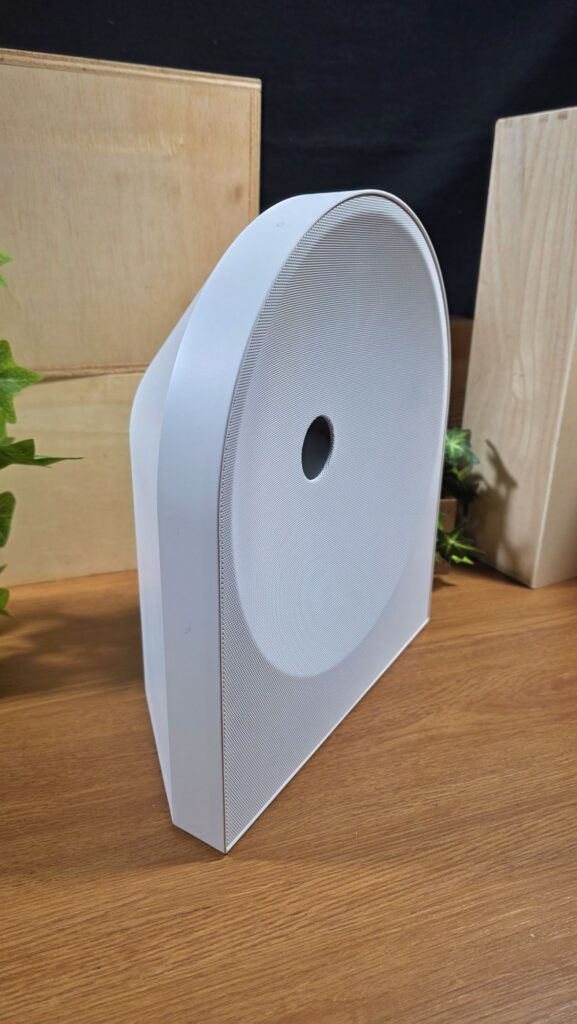
At a glance, the distinctive design is as functional as it is unique looking. Our Samsung Music Studio 5 review sample comes with a polycarbonate chassis done up in a shade of white with matching white grilles and a matte black underside. The Music Studio 5 can also be acquired in a shade of black with a slightly different model number (HW- LS50H).
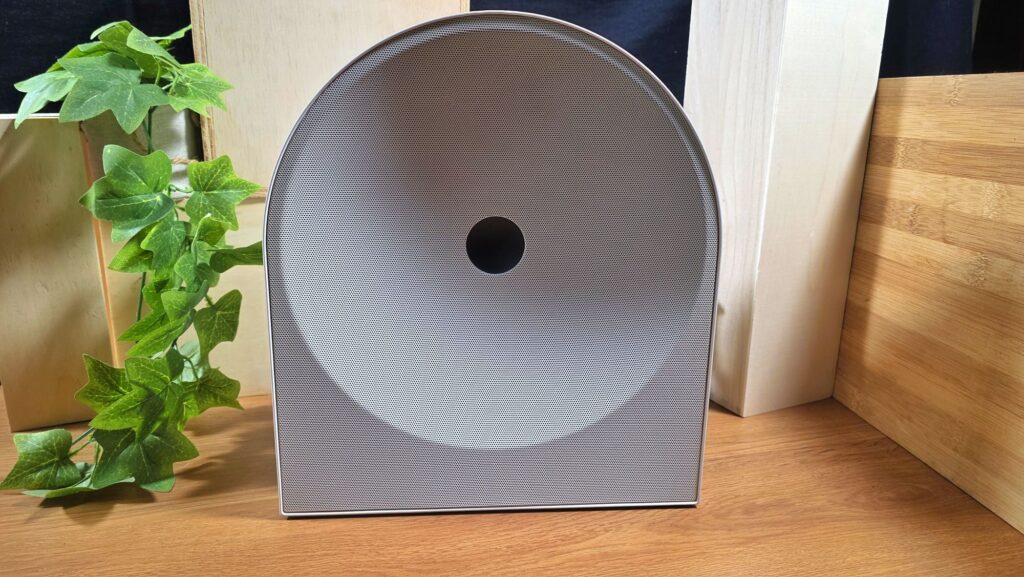
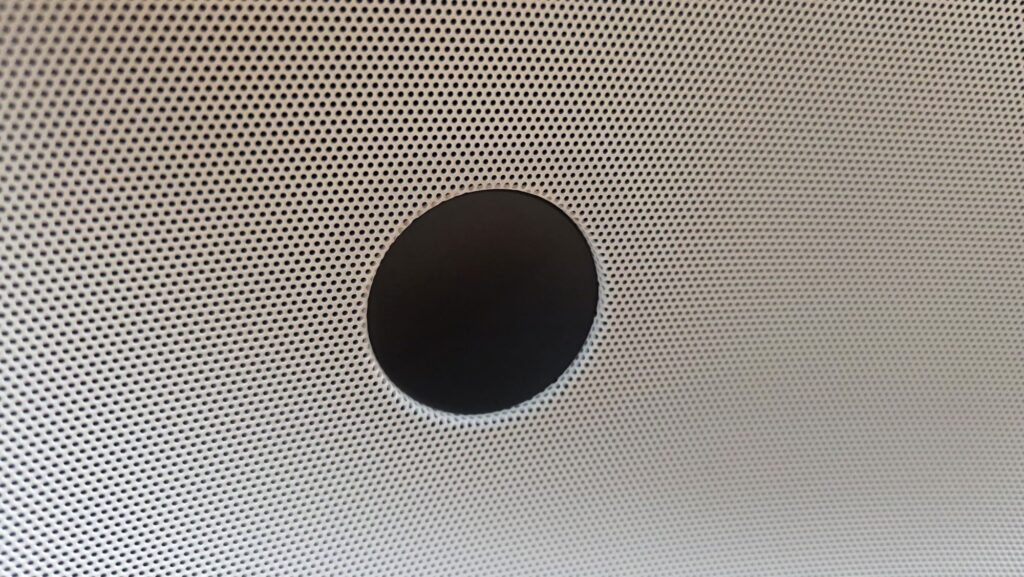
When viewed from the front, the speaker resembles a stylised headstone – an elongated semicircle with a flat base dominated by a large concave indentation in the front and a large black dot that visually draws you in like those popular ‘Magic Eye’ images in the newspapers except that instead of revealing interesting images, you get to reveal a cornucopia of sound with the press of a button.
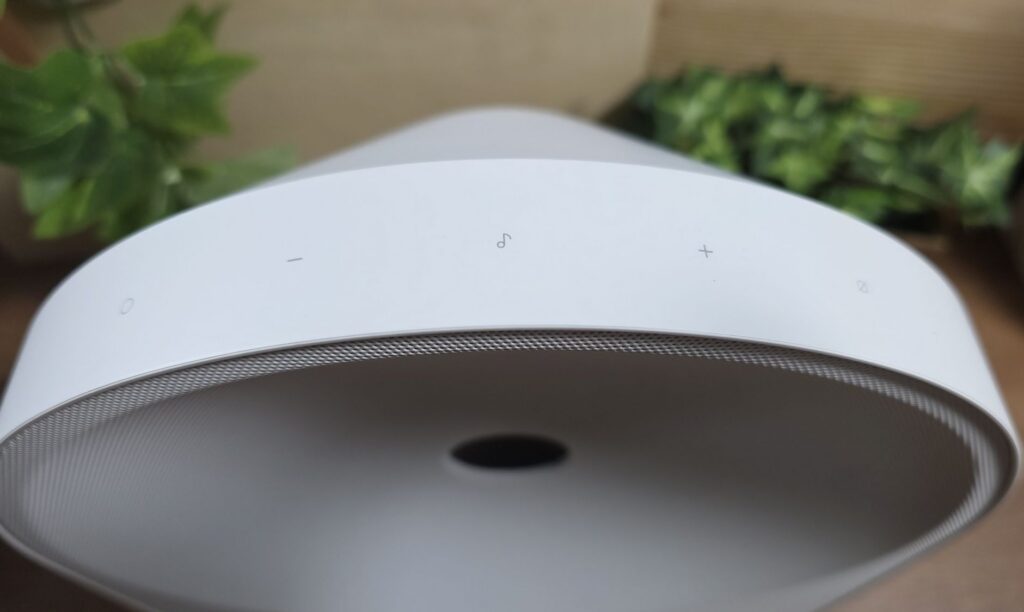
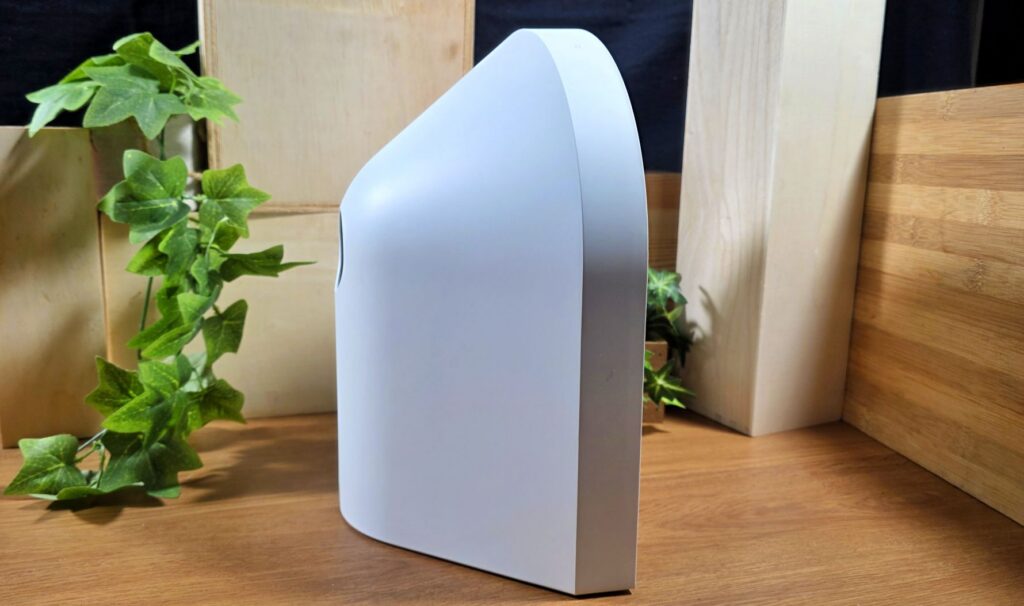
The prominent rear housing lends it a rather thick silhouette when viewed from the side which is necessary to accommodate the rather large dimensions of the woofer while the underside has a slight cutout in the base to accommodate the power cable. Up top, the speaker features a set of touch controls to control volume, the microphone and music playback.
Unfortunately, the touch-sensitive controls on the top of the speaker are flush with the casing and there’s no way to feel for them by touch nor are they backlit which can lead you to randomly stabbing with your fingers about if you don’t have direct line of sight. Fortunately, it’s not a dealbreaker as you can still control the speaker using the Samsung SmartThings app or the Samsung Sound app.
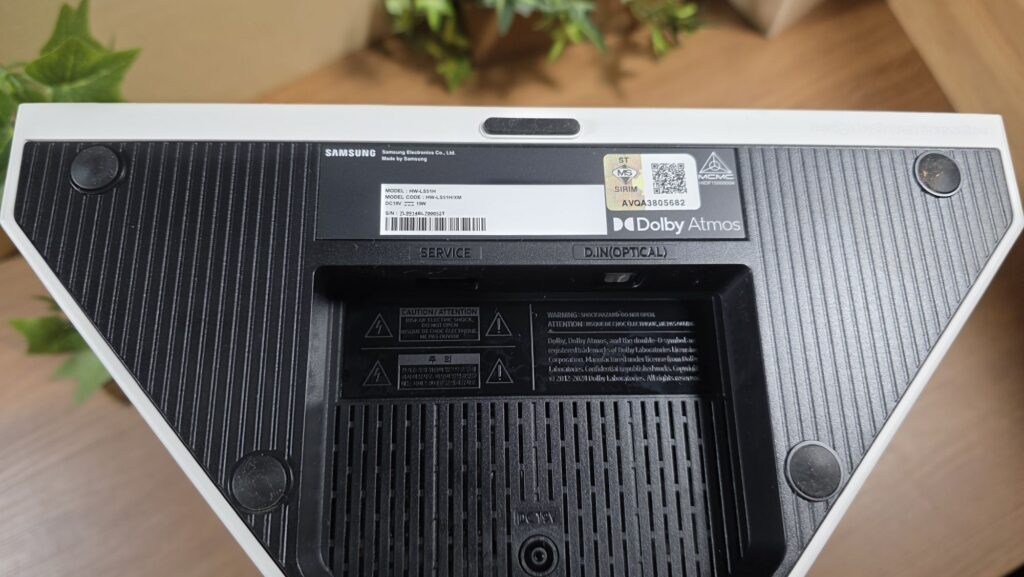
In terms of hardware, the Samsung Music Studio 5 is a 2.0-channel setup that consists of a pair of front-firing tweeters paired with a 4-inch woofer. Connectivity options are comprehensive and it features WiFi, Bluetooth 6.0 as well as an optical-in. The speaker also plays nicely with Apple AirPlay, Google Cast and also has support for Spotify Connect.
Build quality is top-shelf and the speaker is solidly built. However, unlike a number of other wireless speakers in the market, the Music Studio 5’s chunky design and weight mean that it is best suited for indoors use as it won’t fit into a backpack nor is it light enough to be toted around as a party speaker. Unfortunately, it also lacks any dust or water resistance, further relegating it to indoors scenarios.
Even so, the Music Studio 5 is one of the most uniquely designed speakers in the market and makes for an interesting conversation piece when placed in any home setup.
Samsung Music Studio 5 Review – Setup with SmartThings
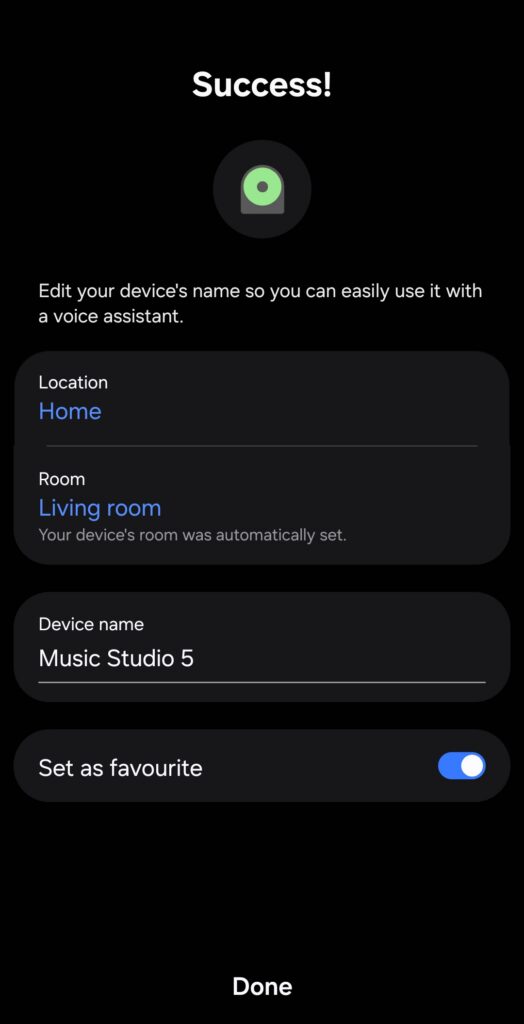
Getting it up and running our Samsung Music Studio 5 review sample was a relatively simple task especially if you’re already in the Samsung ecosystem. The Samsung SmartThings app on a Galaxy S26 Ultra test sample detected our Music Studio 5 review unit and paired up in seconds, allowing you to control almost every aspect of the speaker remotely and rendering the speaker’s touch controls redundant.
As an additional measure of redundancy, you can also alternatively control the speaker remotely via the Samsung Sound app.
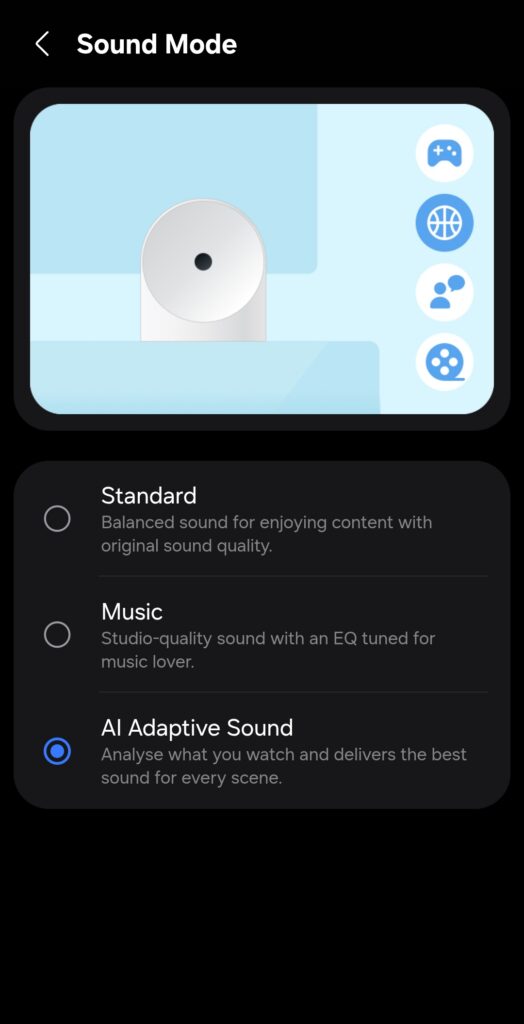
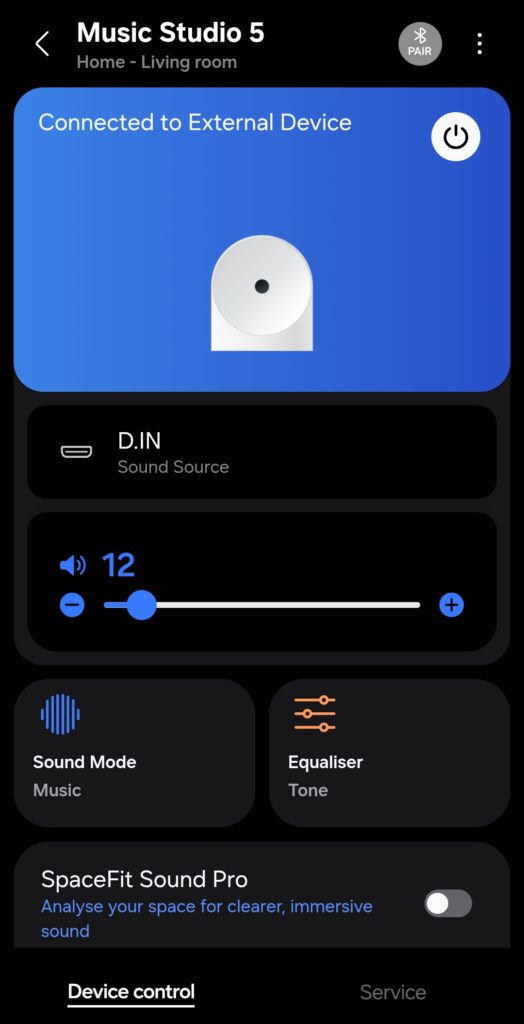
The SmartThings app lets you turn the speaker on and off remotely, control the volume, select a sound source, tweak equaliser settings and also adjust sound modes with your choice of three presets – Standard, Music mode ideal for song playback and an AI Adaptive Sound that optimises sound based on content being played be it movies, podcasts or music.
The app also lets you enable a unique SpaceFit Sound Pro feature that acoustically analyses the immediate area around the speaker and tweaks sound for best effect which is similar in function to Sonos Trueplay.
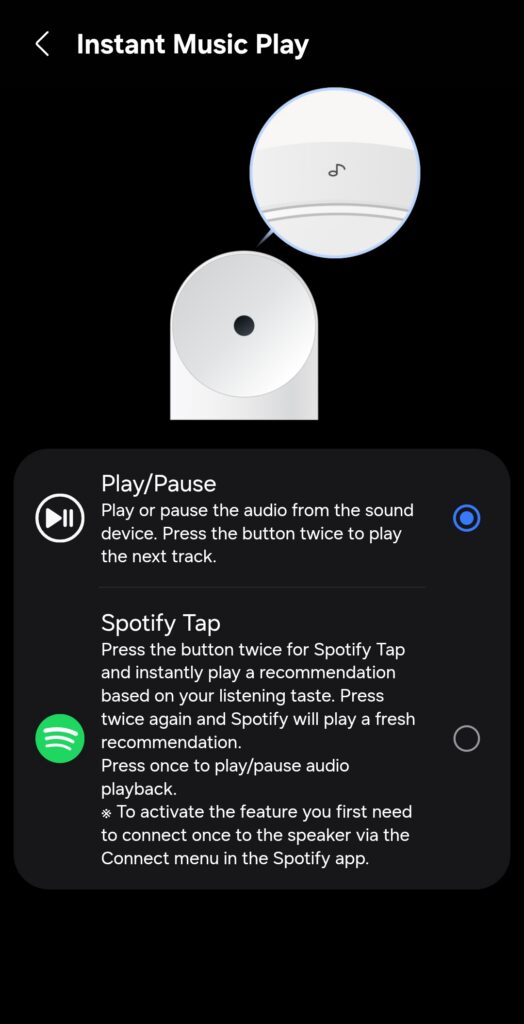
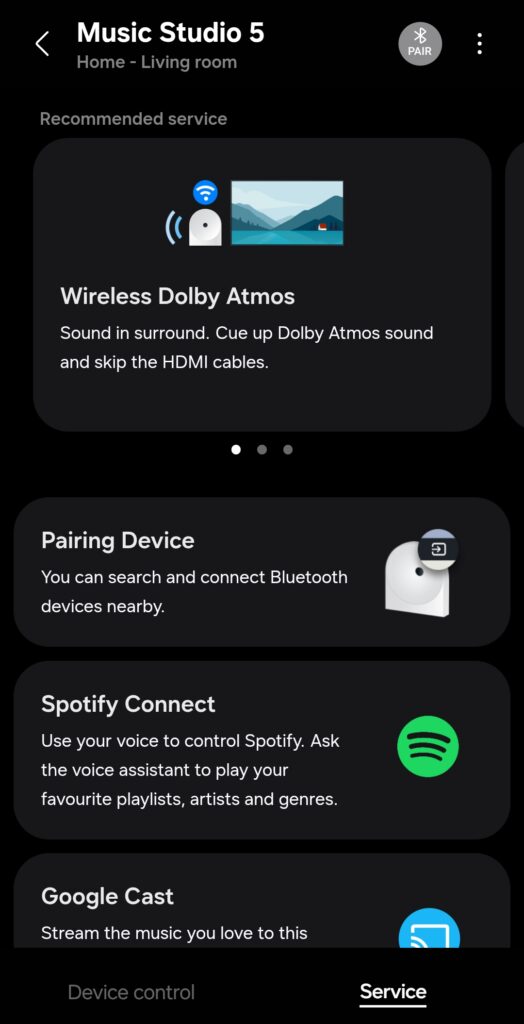
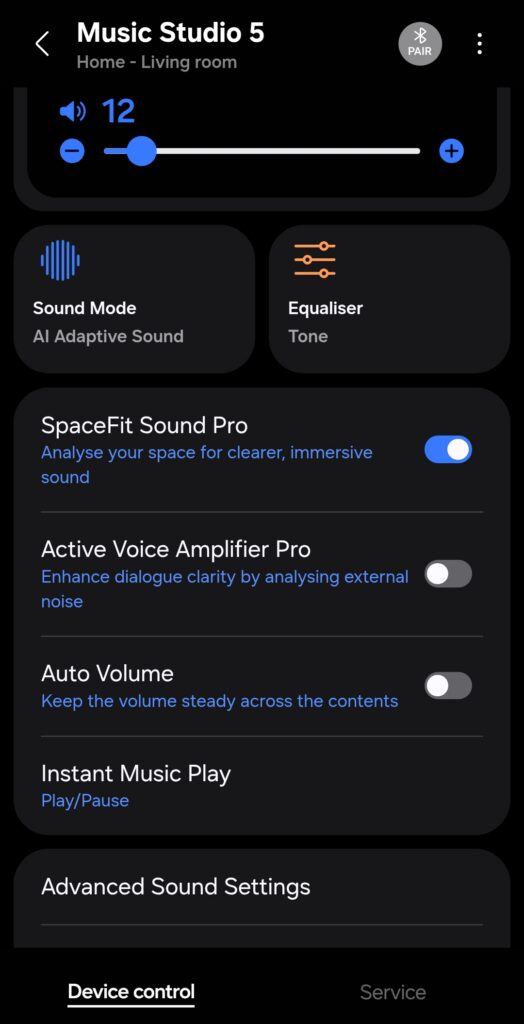
Another useful feature in the app is Auto Volume that intelligently levels out loud content and amplifies quiet ones for more consistent audio along with an Active Voice Amplifier Pro feature that optimises voices in content for better clarity .
While it works fine on its own, you can take advantage of Samsung’s Q-Symphony sound mode to allow it to complement the audio on a Samsung TV of recent vintage or, better yet, pair it up with another Music Studio 5 to form a stereo pair.
The speakers notably have an AI Dynamic Bass Control feature that helps to minimise distortion especially when playing tracks or music with deep bass and also supports Dolby Atmos.
Samsung Music Studio 5 Review – Performance
After all the formalities were sorted, we had our Samsung Music Studio 5 review sample set up as a standalone speaker paired with a Galaxy S26 Ultra.
Notwithstanding its size, the speaker is able to kick out a remarkable amount of sound and even at 30% capacity it was loud enough to fill a living room with sound and at 50% it was loud enough to start getting protests from the neighbours.
Seeing as it is technically a forward-firing speaker, the sweet spot for the Music Studio 5 is directly in front of it which does require some strategic placement in a room setup.
The sound loses some of its richness if you’re listening to it from the sides and especially from the rear but that’s to be expected from the forward-firing nature of its design.
There is some level of virtualised sound staging via Dolby Atmos and Eclipsa Audio tech though this is contingent on the quality of the sound source.
When the stars are in alignment, the Music Studio 5 does offer spacious sound, detail and sound staging though it understandably falls short of the left/right separation you get from a conventional stereo setup unless you pair it with a second Music Studio 5.
When tested with a variety of genres on default settings in Standard mode and with the default balanced equaliser settings, the Samsung Music Studio 5 delivered good mids, clear vocals and surprisingly loud bass that belies its size.
Clarity, especially of separate instruments, was excellent and the Music Studio 5 was able to keep up with Bear McCreary’s ‘Prelude to War’ that has a bass-heavy arrangement with tight, fast-paced drum sequences.
Vocals were exceptionally clear as well with Joanna Wang’s dulcet vocals sounding distinct amidst her guitar strumming in her rendition of ‘Vincent’.
However, in Vaughan Williams’ ‘The Lark Ascending’, the speaker wasn’t able to fully resolve the subtler details in the track like the subtle violin solo and layered strings. There was slightly better detail especially the highs and mids when swapped over to Music mode.
AI Adaptive Sound mode was particularly adept for gaming when testing Call of Duty Mobile with loud and distinct gunfire though sound staging especially for detecting incoming footsteps and gunfire wasn’t particularly distinct or deep. Where it showed its chops was when watching movies.
In the Dark Knight Rises, it managed to offer good sound separation between the background music track and the various sound effects like the hum of police choppers and sirens, the engine hum of Batman’s bike and other sound effects.
When tinkering with its various settings, the Spacefit Sound Pro yielded mixed results. A feature typically seen in Samsung’s higher-end soundbars, Spacefit Sound Pro uses a built-in microphone that measures how sound bounces around the various parts of a room and the speaker adjusts equaliser settings accordingly.
When the speaker was placed in various environments – a clear open office and a denser living room, it seems to primarily boost the mids of tracks for better clarity.
While SpaceFit Sound Pro did make some differences to the presentation in both environments, the changes weren’t particularly dramatic in our testing. Unfortunately, we lacked a second Studio 5 to assess if there was a measurable difference but on its own merits it’s already a very competent standalone speaker.
Should you buy the Samsung Music Studio 5?
The Samsung Music Studio 5 is a stylishly designed and versatile wireless speaker that is easy to set up and capable of handling everything from movies and games to music. While it isn’t aimed at ardent audiophiles, it delivers surprisingly capable sound across a variety of mainstream musical genres straight out of the box.

If you’re already in the Samsung ecosystem, this comes recommended as a convenient way to add extra oomph to your music listening.
Specifications
Price RM999
Channel 2.0, 2 x Tweeters, 1 x Woofer
Supported formats MP3, AAC, OGG, FLAC, WAV, ALAC, AIFF
Connectivity Bluetooth 6.0, WiFi
Size/Weight 251 x 283.5 x 137mm / 2.4kg
Samsung Music Studio 5 review sample. For more details and to purchase please visit https://www.samsung.com/my/audio-devices/wireless-speaker/ls51h-white-hw-ls51h-xm/
Samsung Music Studio 5
-
Performance
-
Value
-
Connectivity
-
Design
Samsung Music Studio 5
Featuring a distinctive design, the Samsung Music Studio 5 is a capable wireless speaker that is able to offer impressive volume for its size and relatively detailed sound. While it is intended more for general music listening rather than for ardent audiophiles, it is more than capable of tackling a variety of music genres straight out of the box.
Pros
Unique minimalist design by Erwan Bouroullec
Impressive volume output
Good bass for size
Easy connectivity
Cons
Controls on the top are hard to feel by touch