
Dell Technologies: AI PCs and Workstations Power Asia-Pacific’s Shift to a Powerful Distributed AI Future
Once considered as a strategic wildcard or as an optional supplement to existing workflows, AI has, in recent years, becoming increasingly critical to remain competitive especially in uncertain times with soaring costs and reduced budgets for digitalisation initiatives.
While early trends pointed towards cloud-based AI initiatives as efficient cost consolidation, hard-won experience has led organisations to pivot to distributed AI with fleets of AI PCs and workstations equipped with neural processing units (NPUs) to distribute workloads while optimising cost efficiency without compromising security.
To determine the lay of the land, Dell Technologies and Intel commissioned not one but two IDC InfoBriefs titled – Future-Ready Workforce: The Strategic Case for AI PC Adoption and Powering Future-Ready Computing with Workstations: Built for AI. Built for You. At a top level the reports delve deeper into the momentum and the impact that higher-performance, AI-enabled endpoints have as organisations pivot towards more robust AI adoption.
According to the studies commissioned by Dell Technologies and Intel, 48% of organisations with more than 500 employees in the Asia Pacific region were already deploying AI PCs and 95% expected that workstations will play a critical role in AI initiatives over the next two years.
“AI is changing where work happens and where intelligence needs to live,” said Jacinta Quah, Vice President, Client Solutions Group & Modern Workplace, Asia Pacific, Japan and Greater China (APJC), Dell Technologies.
“AI PCs and workstations are not simply device categories in a refresh cycle – they are foundational platforms built for a future-ready enterprise AI era. AI PCs bring intelligence to everyday workflows, at the fingertips of employees where data is generated. Meanwhile, workstations provide the performance and control needed for more specialized, compute-intensive workloads. Together, they enable organisations to scale AI more effectively, strengthen security and privacy, and drive meaningful business outcomes.”
Dell Technologies – How are AI PCs Powering a Distributed AI Future in Asia Pacific?
Table of Contents
According to Dell Technologies, the growing enterprise momentum in intelligent endpoints and higher performance systems reflects a broader industry trend towards aligning the right compute resources with specific workload requirements as organisations balance intelligent endpoints for everyday productivity with high-performance systems designed for advanced AI and specialised use cases.
This approach supports enhanced data privacy and security, provides IT teams with greater control over deployment and management across device fleets and offers more granular and consistent scaling of AI capabilities across the workforce.
AI PCs also allows for a new category of enterprise use cases including real-time collaboration and report generation to natural language search and content creation which deliver tangible productivity gains across the board.
On the front lines, AI PCs are able to deliver insights that can lead to actionable outputs – faster and more targeted proposal turnaround for sales teams, more rapid and accurate analysis cycles for finance and operations, more efficient drafting for human resources and more.
It is becoming increasingly clear that AI PCs are becoming the governed way to scale intelligent experiences across the workforce in a safe, consistent manner with clearer business impact.
Based on IDC research, AI has become embedded in day-to-day work and device strategy has shifted accordingly. 89% of Asia Pacific organisations now consider AI capabilities a critical factor in future PC purchasing decisions which has been emphasised in key markets in Asia Pacific.
In China, this urgency is reinforced by recognition of the risks to employee engagement and decision quality if AI PC adoption is delayed.
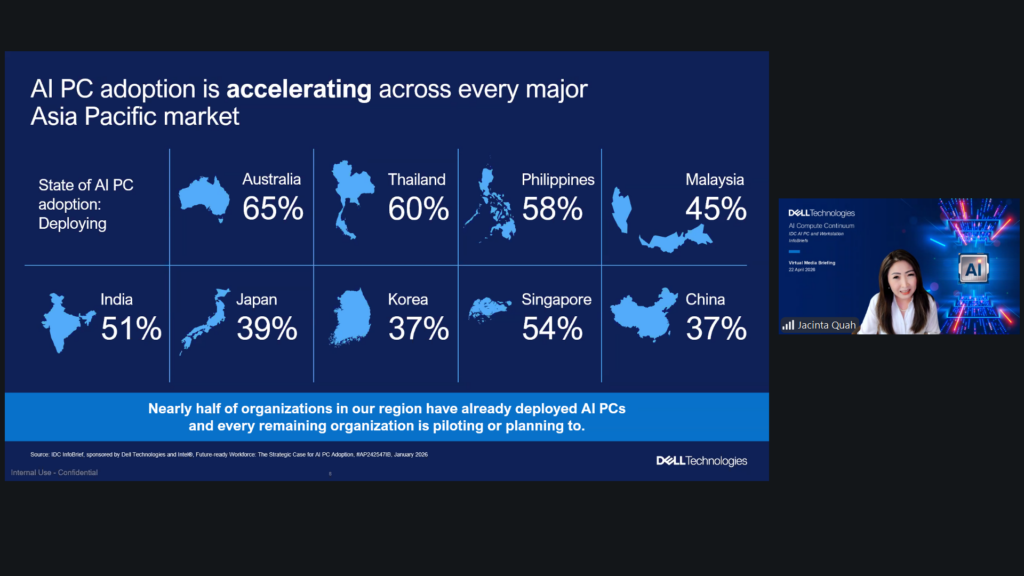
To date, 65% of organisations in Australia have deployed AI PCs in their workforce which is 23% higher than the regional average. Similar trends are observed in India (51%), Japan (39%), South Korea (37%), and China (37%).
In Southeast Asia, AI PC adoption is outpacing the regional average by 6%, with Singapore (54%), Malaysia (45%), Thailand (60%), and the Philippines (58%) seeing rapid adoption with the ability to deploy new technologies without legacy constraints, robust infrastructure in markets like Singapore and supportive government initiatives.
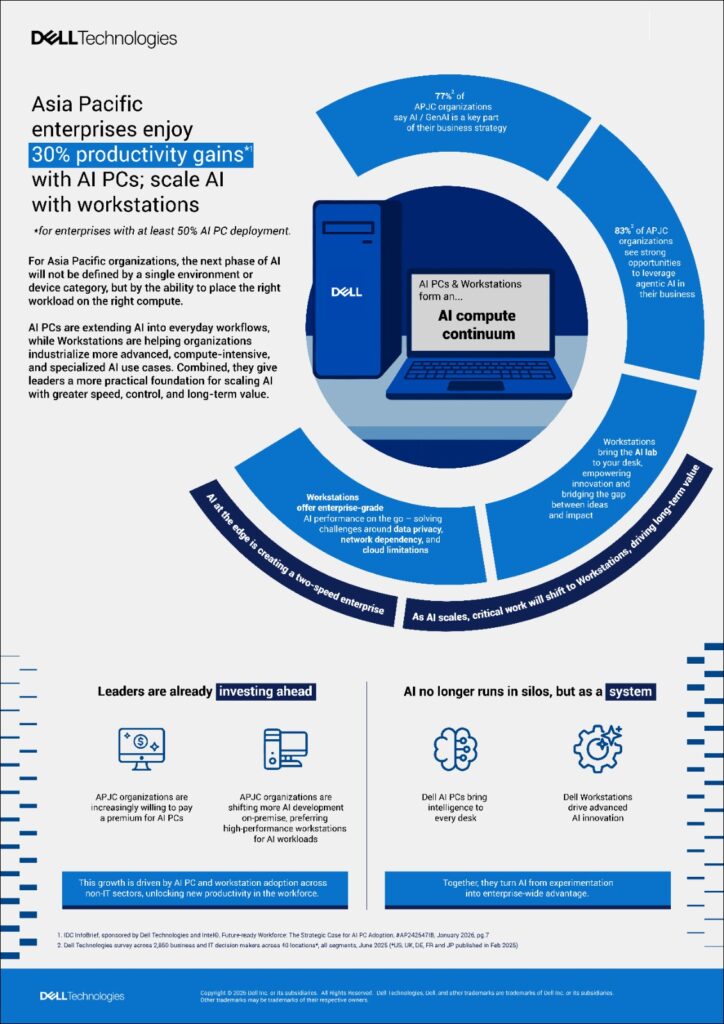
Further research also discovered that organisations with over 50% AI PCs in their fleet report saving 2.17 hours per employee per day which represents a 30% productivity increase compared to using AI on traditional PCs.
Four out of five Asia Pacific organisations also expect that AI PCs will drive adoption of agentic AI with an equal number agreeing that they enhance control and security in these applications.
Based on studies, 84% of organisations expect AI PCs to increase employee productivity, while 78% cite security benefits and 77% highlight cost advantages of running AI locally. In Southeast Asia, 57% of organisations prioritise security when considering AI PCs. This impetus towards adoption is such that 65% in Asia Pacific are willing to pay a 10% or more premium for AI PCs.
Dell Technologies – How are AI Workstations Driving AI Initiatives in Asia Pacific organisations?
Where AI PCs distribute intelligence across a workforce, AI workstations act as the backbone for demanding workloads with developers, engineers, designers and data teams relying on workstation-class systems for AI Model development, simulation ,rendering, data preparation and other compute-intensive activities that require low latency, reliability and sustained performance.
Based on Dell Technologies’ commissioned reports, 92% of organisations surveyed across Southeast Asia reported higher productivity among workstation users and 52% expect their workstation fleet to grow over the next five years.
Further, 66% of organisations employ workstations for data preparation, 62% use them for model fine-tuning while 55% use them for foundational model training which represents a disproportionately high integration in professional workloads in the Southeast Asia region.
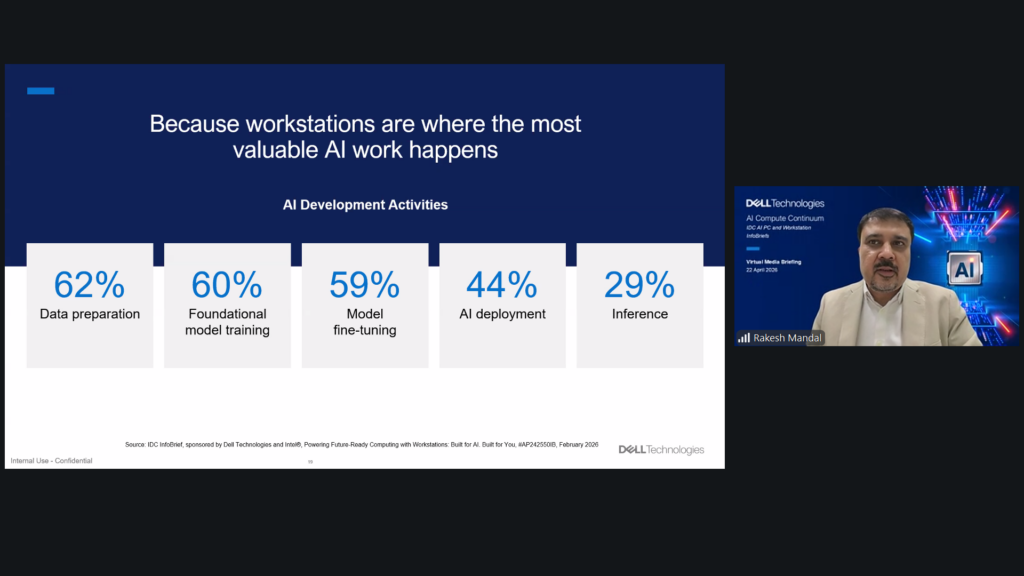
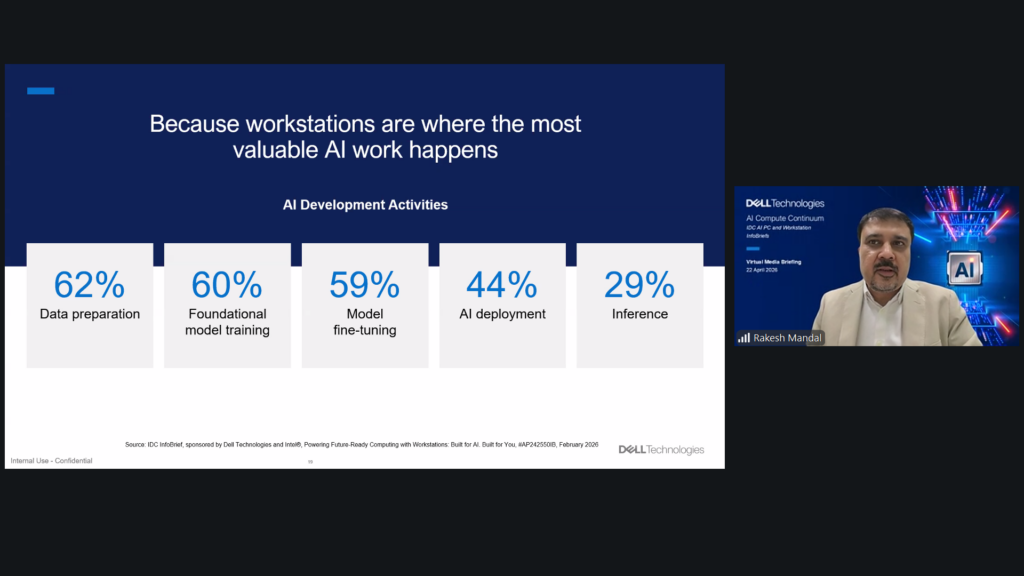
Naturally, use cases vary by sector but AI has become the top technical computing use case for workstations, supporting the full lifecycle from data preparation (62%) and model training (60%) to fine-tuning (59%), deployment (44%) and inference (29%).
This use case across the full lifecycle means that the strategic paradigm alters from upfront device price to total cost of ownership. As AI initiatives move closer to production, workstations are being considered as long-term investments that can scale with evolving workloads rather than being merely considered for research and development applications.
Dell Technologies – The AI Compute Continuum and an AI Future
The next phase of AI for organisations across the Asia Pacific region will not be defined by a single environment or device category but by the ability to place the right workload on the right compute.
With AI PCs seeing increasing adoption into everyday workflows while workstations are being integrated into compute-intensive use cases, stakeholders are able to scale AI with greater speed, control and long term value. For additional reading, the IDC reports can be accessed here and here.