
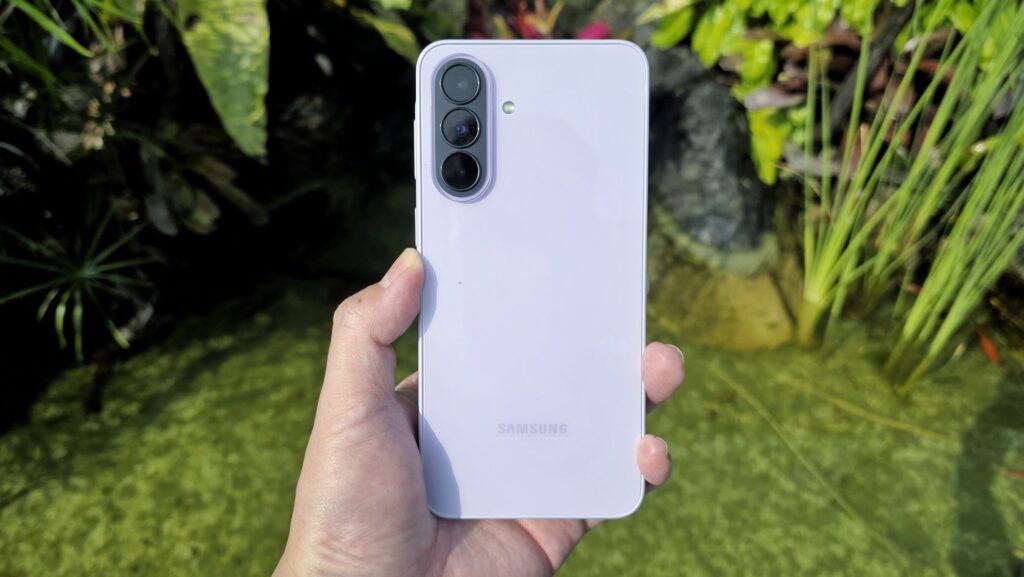
Samsung Galaxy A37 Review – Lovely Lavender Midranger
Launched alongside the Galaxy A57, the new Galaxy A37 is a midrange workhorse phone with an interesting emphasis this time around as a phone that’s optimised for gaming. We were issued a unit for field testing and after putting it through its paces, here’s our Samsung Galaxy A37 review to see if it’s worth the upgrade.
Samsung Galaxy A37 review – Build and design
Table of Contents
This time around, Samsung plays it safe with the build and design of the Galaxy A37 and doesn’t rock the boat with modest upgrades to the hardware while featuring slight aesthetic changes compared to its predecessor the Galaxy A35.
When the Galaxy A37 and Galaxy A37 are placed side by side, their similarities are apparent. Both feature rounded corners, a flat front and rear as well as straight edges. The biggest difference between the Galaxy A37 and older A35 is that the Galaxy A37 has a larger, pill-shaped camera housing that encompasses all three of its cameras while the Galaxy A35 has three separate camera housings.

Bar that cosmetic difference, our Galaxy A37 review sample also sports a new array of colourways and is also slightly thinner at 7.4mm and lighter at 196g than the prior model.
Samsung has also improved the dust and water resistance with an IP68 rating over the older model’s IP67 rating, allowing the newer Galaxy A37 to survive in up to 1.5 meters of fresh water for up to 30 minutes. However, the phone has no quoted MIL-STD-810H rating for drop resistance or resistance to shock.
Closer inspection also reveals that the Galaxy A37 has a slightly larger 6.7-inch Super AMOLED display that is a bit larger by 0.1 inches than the Galaxy A35 on account of shaving down the screen bezels.
The display itself has a similar 1080 x 2,340 pixels resolution with a 120Hz refresh rate but is brighter than before with a quoted 1,900 nits peak brightness which comes in handy when used outdoors in sunlight. Up top, the phone has a punchhole for a single 12MP selfie camera with the bottom quadrant featuring an in-display fingerprint reader.
As an added measure of protection, the screen is also protected by Gorilla Glass Victus+ which also covers the polycarbonate backplate. The backplate also features a glossy finish that is surprisingly fingerprint resistant.
The left of our Galaxy A37 review sample is otherwise unremarkable with the right featuring a power button and volume rocker. The base sports a SIM card tray with a USB-C port and a grille for the bottom-firing speaker that gives the phone stereo sound combined with the one at the top of the display.

Overall build quality is solid with a good heft and ergonomics which are helped in part by the raised island around the power button and volume rocker which lets you feel for it by touch. All summed up, you get a slightly larger and brighter display and a slightly more water resistant chassis that is also lighter and thinner in the bargain.
@hitechcentury Unboxing the new Samsung Galaxy A37 5G that comes in three cool colourways, a huge battery and large display for casual gaming on the go! #galaxya375g #NgamAtNight #NgamLaju #AYETetapNgam @Samsung Malaysia ♬ original sound – Hitech Century
Much like prior Samsung Galaxy A-series models, there’s little in the package beyond a USB-C charging cable, a SIM card ejector pin, paperwork and the phone itself.
Samsung Galaxy A37 review – Performance and benchmarks
On the hardware front, the Galaxy A37 plays it safe with a modest upgrade to the hardware. Rather than a new chipset, the phone uses Samsung’s own Exynos 1480 processor that saw service in the Galaxy A55 that was released in early 2024. This is paired with 12GB LPDDR5X RAM and 256GB UFS 3.1 storage. Another more affordable Galaxy A37 variant exists which has similar storage but only 8GB RAM.
The phone also runs the latest Android 16 with Samsung’s own One UI 8.5 with its bevy of AI features though not all are available on the Galaxy A37, presumably due to the hardware and also for product differentiation purposes.
On the bright side, OneUI 8.5 does confer a more capable Bixby AI assistant that is capable of comprehending natural queries and featuring greater system access. With the upgraded Bixby, you can request or highlight an issue with the phoneand Bixby can amend the setting or send you off to the necessary menu such as increasing volume, modifying screen brightness and the like.
Unfortunately, the Galaxy A37 still lacks DeX desktop mode which is currently exclusive to their flagship Galaxy S and Z series phones which would have added to its value but this is likely to ensure the flagship models remain unique.
Of particular note is that Samsung has committed to offering the Galaxy A37 an impressive six OS updates and six years of security updates which means it will stay updated all the way till Android 22 and get security updates all the way to 2032.
| Price | RM1,899 [12GB RAM/256GB] , RM1,699 [8GB RAM/256GB] |
| Display | 6.7-inch Super AMOLED, 1080 x 2,340 pixels, 120Hz refresh rate, 1,900 nits peak brightness |
| Processor | Exynos 1480 |
| OS | Android 16 w/ OneUI 8.5 |
| Memory | 12GB LPDDR5X RAM / 256GB UFS 3.1 | 8GB RAM variant available |
| Cameras | 50MP f/1.8 w/ OIS, 8MP f/2.2 ultra wide angle + 5MP f/2.4 macro [rear] / 12MP f/2.2 [front] |
| Battery | 5,000mAh w/ 45W wired |
| Size/Weight | 162.9 x 78.2 x 7.4mm / 196g |
Like prior Galaxy A series phones, our Samsung Galaxy A37 review sample has the ability to assign up to 12GB of virtual RAM off the assigned storage in 2GB increments or, optionally, disable it entirely. With the default of 4GB of virtual RAM off the onboard storage, we got the following benchmarks:
| 3D Mark Steel Nomad Light | 482 |
| 3D Mark Steel Nomad Light Unlimited | 486 |
| 3D Mark Wild Life | 3,970 |
| 3D Mark Wild Life Unlimited | 4,030 |
| 3D Mark Wild Life Extreme | 1,073 |
| 3D Mark Wild Life Extreme Unlimited | 1,058 |
| Geekbench 6 Single core | 1,137 |
| Geekbench 6 Multi core | 3,462 |
| Geekbench 6 OpenCL | 4,005 |
| Geekbench 6 Vulkan | 4,165 |
| Geekbench AI (CPU quantised) | 2,212 |
| Geekbench AI (GPU quantised) | 480 |
| PC Mark Work 3.0 | 14,509 |
| PC Mark Battery Life | 16 hours 12 mins |
In terms of single, multicore and graphics performance, the Exynos 1480 in our Galaxy A37 review sample has scores similar to that of the earlier Galaxy A55 which are respectable for a midrange phone. The Galaxy A37 isn’t going to break any speed records but acquits itself respectably in day-to-day use for a midrange phone.


The Galaxy A37 offered smooth performance when browsing and swapping between multiple tabs in Chrome, when editing text and spreadsheets in Google Doc and editing 1080p videos on CapCut.


Gaming was handled relatively smoothly on most common games like Call of Duty Mobile, Genshin Impact and Asphalt 9 on default settings and was even able to run more recent games like Wuthering Waves and Where Winds Meet on low settings without too much trouble.


Heat was also well managed on the phone and even across gaming sessions that spanned several hours, our Galaxy A37 review sample remained slightly warm to the touch. In the Steel Nomad Light stress test, the phone maxed out at 35°C which is decent as things go. Of greater value is that the phone supports bypass charging though this is nested in the optional Game Booster mode and only if you have a compatible charger that supports PPS 25W or higher and the battery has over 20% charge.


The Super AMOLED display offered bright and vibrant visuals with good clarity even under direct sunlight while its accompanying stereo speakers offered sufficient volume for gaming and watching movies on a casual basis.

In terms of battery life, the Galaxy A37 has modest improvements and has a good full day and a half of normal usage like web browsing, social media, a few minutes of calls and some light gaming with the PC Mark battery life benchmark offering 16 hours and 12 minutes of usage.
If you’re going in full tilt with a full Netflix binging session or you’re undertaking an extended gaming marathon, expect shorter battery life. Fortunately, Samsung has improved charging speeds this time around with the phone offering 45W wired charging with a compatible charger allowing it to get a full charge from dead zero in about an hour and 15 minutes.
Samsung Galaxy A37 Review – Cameras
The Samsung Galaxy A37 has a camera setup that is somewhat akin to the Galaxy A57 that we previously tested with the notable swap of a smaller 8MP ultra wide angle camera. The pricier Galaxy A57 instead has a more capable 12MP ultra wide angle camera.

The main camera of the Galaxy A37 is otherwise identical to that on the Galaxy A57 with a 50MP f/1.8 sensor that has optical image stabilisation as well as a 5MP f/2.4 macro camera riding shotgun. Combined, this allows for stills and up to 4K@30fps with 2x lossless zoom by cropping the main sensor and up to 10X digital zoom. Up front, the phone has a single 12MP camera for selfies and up to 4K@30fps video capture.


In brightly lit daytime conditions, the ultrawide and main cameras offer good dynamic range and detail with well saturated colours though the ultra wide angle camera has slightly softer but very usable images compared to the results offered with the Galaxy A57’s more capable 12MP ultrawide angle camera. Shots on our Galaxy A37 review unit are good out to 2x zoom with the 10x zoom being more of a novelty along with the macro camera which is useful only in up-close shots.

Samsung Galaxy A37 Review – Ultrawide camera dawn

Samsung Galaxy A37 Review – 1X zoom at dawn

Samsung Galaxy A37 Review – 2X zoom

Samsung Galaxy A37 Review – 4X zoom dawn

Samsung Galaxy A37 Review – 10x zoom dawn
Performance in low light offers mixed results. The ultrawide camera and the main camera require a substantial two second exposure delay the moment you press the shutter release but are able to yield decent results.


However, shots from 2X up to 10X end up with darker output in comparison which is understandable seeing as the phone lacks a true telephoto camera and is just cropping in from the main camera sensor and is likely skipping heavy post processing in exchange for retaining detail.

Fortunately, this is primarily in extreme scenarios like the dawn shot picture depicted earlier. In urban scenarios at night with a modicum of lighting from signage and street lamps, the Galaxy A37 offers decent shots at 2x. Selfies from the camera are decent with good skin tones in brightly lit scenarios with less impressive results in dim light.

Videos captured on the rear main camera at 4K@30fps are stable thanks to OIS with good detail and colour rendition at up to 2x zoom in daylight conditions and the usual night urbanscapes with detail understandably getting soft with poorer dynamic range and detail after that. It’s best to stick to 2x zoom at most when filming footage.
While overall results fall short of what is required of content creators, the Galaxy A37’s camera setup is more than sufficient for most users to cover the usual range of subjects encountered in everyday Malaysian life – food, friends, family, scenery and the odd shot or two of where you parked your car.
Should you buy the Samsung Galaxy A37?
As it stands, the Samsung Galaxy A37 features a conservative, balanced set of upgrades that include a slightly larger and brighter Super AMOLED display, improved performance, faster charging and upgraded IP68 dust and water resistance in a slimmer and thinner chassis.
Overall, the Galaxy A37 is a well rounded midrange design but where it stands out from the crowd is its longevity, with Samsung committing to an impressive six OS and six years of security updates which lends it a service life longer than other competing midrange phones and better value over time. If you can, acquire the higher end 12GB RAM variant as it offers a smoother user experience and better longevity as apps become more demanding over time.

Samsung Galaxy A37 review sample courtesy of Samsung Malaysia. For more details please visit https://www.samsung.com/my/smartphones/galaxy-a/galaxy-a37-5g-awesome-lavender-256gb-sm-a376blvuxme/buy/
Samsung Galaxy A37
-
Display
-
Performance
-
Cameras
-
Battery Life
-
AI Capabilities
-
Value
Samsung Galaxy A37
The Samsung Galaxy A37 features a conservative, balanced set of upgrades that include a slightly larger and brighter Super AMOLED display, improved performance, faster charging, upgraded IP68 dust and water resistance in a slimmer and thinner chassis and the addition of a respectable six years of OS and security updates.
Pros
Generous 6 years of OS and security updates
Bright display
Decent cameras for general usage
Stereo speakers
Cons
Conservative upgrades
Lacks free accessories beyond a single USB cable
No DeX mode
No microSD card